FREE QUOTE CALL OR TEXT
0424 408 330
Trusted by Builders, Strata Managers & Property Owners
GET YOUR JOB BOOKED IN AND FINISHED TODAY !!
"*" indicates required fields
Concrete Cancer Repairs Sydney

Concrete cancer can weaken the structural integrity, safety, and appearance of a property if it is not addressed early. At Floor Levelling Sydney, we specialise in professional concrete cancer repair and remediation services across Sydney and surrounding areas, restoring damaged concrete and preventing further deterioration.
Our team offers FREE Site Inspections and QUOTES for concrete cancer and concrete spalling repairs throughout Sydney.
FREE QUOTE CALL OR TEXT 0424 408 330
Trusted by Builders, Strata Managers & Property Owners
GET YOUR JOB BOOKED IN AND FINISHED TODAY !!
"*" indicates required fields

FREE PRICE BEAT GUARANTEE
QUOTE
We’ll Beat ALL Quotes By Up To 10%
Conditions apply. *Cannot be used in conjunction with any other offer.
Concrete Spalling Repairs Service Sydney
Concrete Spalling Repairs Service Sydney
Concrete Cancer Repair Service Sydney
Concrete cancer repairs should always be carried out by experienced professionals. When left untreated, concrete cancer can continue to spread through the structure, weakening the integrity of the concrete and leading to far more expensive repairs or, in severe cases, serious structural failure.
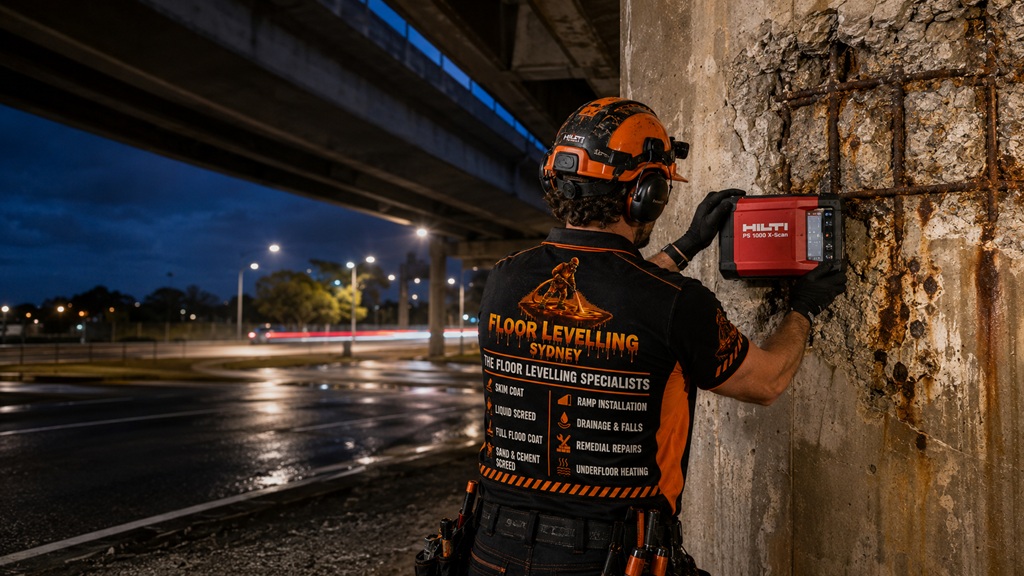
Concrete cancer repair involves removing deteriorated concrete, treating the corroded reinforcing steel, and restoring the damaged area using specialised repair mortars and structural repair systems. The process generally includes saw-cutting the affected concrete, cleaning and protecting exposed reinforcement, and rebuilding the area with high-performance repair materials designed for long-term durability. Protective waterproofing systems are then applied to help prevent moisture ingress and future deterioration.
Many residential and commercial buildings constructed between the 1920s and 1990s contain magnesite flooring, a material known to accelerate concrete cancer by trapping moisture and salts within the concrete slab. Removing Magnesite Flooring and carrying out timely concrete repairs is often essential to prevent ongoing structural damage.
Properties located near coastal environments are also at a greater risk of developing concrete cancer. Salt-laden air can penetrate concrete surfaces and significantly accelerate the corrosion of internal steel reinforcement, causing damage to develop more rapidly than in inland areas.
Our team performs detailed concrete cancer inspections to determine the root cause of the deterioration. By identifying the underlying issue—whether it is moisture ingress, salt exposure, carbonation, or failed waterproofing—we can implement targeted repair strategies that provide long-lasting structural solutions.
If you suspect concrete cancer in your property, CONTACT US NOW FOR A FREE ONSITE INSPECTION. Our experienced team will assess the damage and provide a detailed quote outlining the most effective method to repair and restore your concrete.
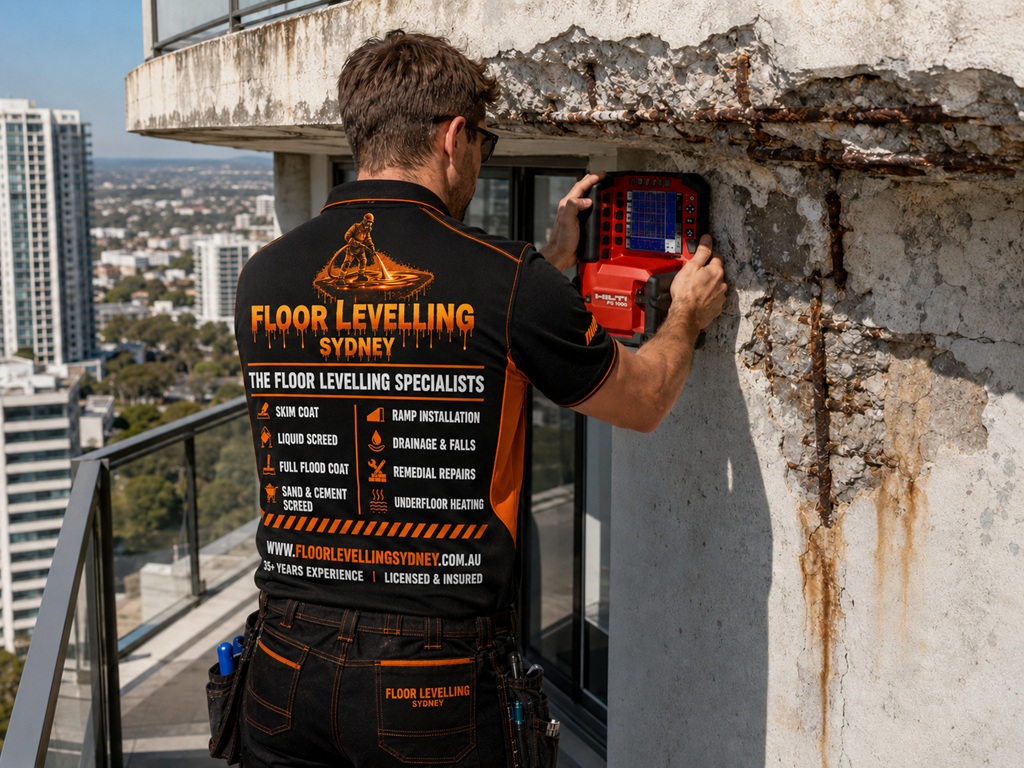
Why Choose Floor Levelling Sydney’s Team To Repair Your Concrete Cancer & Concrete Spalling?
At Floor Levelling Sydney, we focus on delivering high-quality workmanship backed by industry expertise, modern equipment, and a strong commitment to customer satisfaction.
Dust-Free Technology:
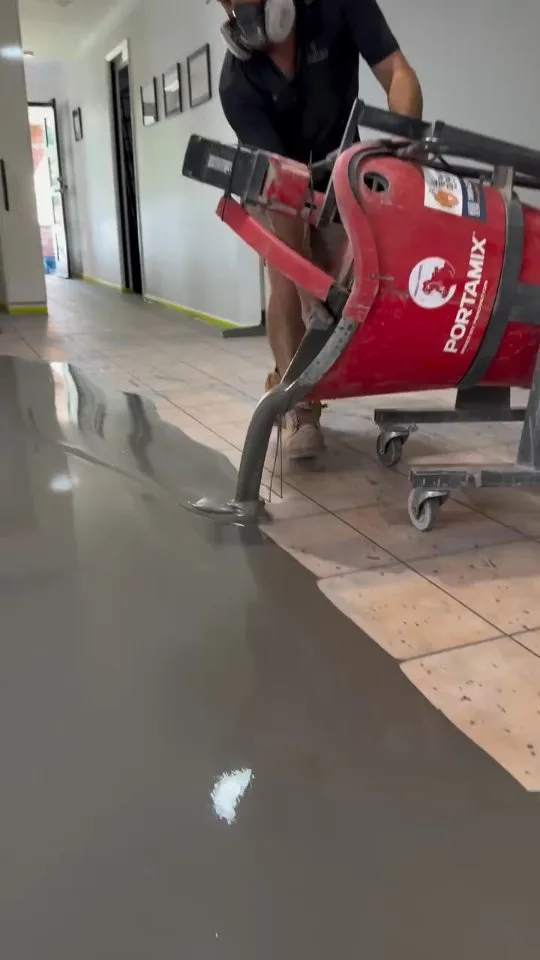
We utilise advanced dust extraction and suppression systems during the repair process to minimise airborne debris. This helps keep the worksite cleaner, protects surrounding areas of the property, and significantly reduces post-project clean-up.
Over 35 Years Of Industry Experience:
With more than three decades of experience across a wide range of concrete repair projects, our team brings extensive technical knowledge and hands-on expertise. We understand the complexities of concrete deterioration and know how to restore structural strength effectively.
Fully Licensed And Insured:
Floor Levelling Sydney operates with full industry licensing and comprehensive insurance coverage, ensuring every project is carried out safely, professionally, and in accordance with Australian standards.
Modern High-Performance Equipment:
We utilise advanced tools and specialised machinery designed for precision concrete repairs. This allows us to efficiently handle everything from minor surface deterioration to large-scale structural damage.
Competitive Pricing With Quote-Beat Promise:
We pride ourselves on offering competitive pricing without compromising quality. If you receive a written quote from another contractor, we will beat it by up to 10%*.
Complete Concrete Repair Solutions:
Our services go beyond basic repairs. From detailed inspections and structural restoration to surface finishing, we provide complete solutions for concrete cancer and spalling repairs across Sydney.
Long-Term Warranty Options:
Quality repairs should last. Depending on the materials and repair system used, we offer warranties ranging from 7 to 30 years, providing long-term confidence in the durability of your repaired concrete.
Customer-Focused Service:
We prioritise clear communication, reliable service, and high-quality results on every project. Our goal is to deliver repair solutions that exceed expectations and protect your property for years to come.
Premium Industry-Compliant Materials:
All repair materials used meet strict Australian standards, ensuring strength, durability, and long-term performance under Australian environmental conditions.
Tailored Repair Strategies:
Every structure is different. We carefully assess each project and design a customised repair plan based on the severity of the damage and the underlying cause of the concrete cancer.

How Concrete Cancer Develops
Concrete cancer, commonly referred to as concrete spalling, occurs when the reinforcing steel embedded within the concrete begins to corrode. As rust forms, the steel expands and places outward pressure on the surrounding concrete. This expansion causes cracking, flaking, and surface deterioration.
Once the concrete surface is compromised, moisture and contaminants can enter the structure, accelerating the corrosion process and worsening the damage.
Common signs of concrete cancer include:
– Rust staining on concrete surfaces
– Cracks appearing in the concrete
– Flaking or crumbling concrete sections
– Surface bubbling or blistering
– Hollow-sounding concrete areas
– Exposed reinforcement steel
Our Concrete Cancer Repair Process
Step 1: Free Inspection And Quote
Our process begins with an onsite inspection to assess the condition of the concrete and determine the extent of the damage. A detailed quote is then provided outlining the recommended repairs.
Step 2: Structural Assessment
We analyse the affected area to identify the underlying cause of the deterioration and determine how far the damage has spread.
Step 3: Removal Of Damaged Concrete
The affected concrete is carefully cut and removed to create a defined repair area and prevent the damage from extending further.
Step 4: Controlled Concrete Removal
Using specialised equipment designed to minimise dust, we remove weakened concrete surrounding the reinforcement.
Step 5: Cleaning The Reinforcement
Any corrosion present on the steel reinforcement is removed using mechanical cleaning methods such as wire brushing.
Step 6: Surface Preparation
The exposed steel and surrounding concrete are cleaned to ensure optimal adhesion of primers and repair materials.
Step 7: Anti-Corrosion Protection
Protective primers and anti-corrosion coatings are applied to the reinforcement to help prevent future rust development.
Step 8: Reinforcement Replacement If Required
If the existing reinforcement is significantly compromised, it may be replaced or supplemented with new steel bars to restore structural strength.
Step 9: Waterproof Protection System
A protective barrier is installed to prevent moisture penetration and reduce the risk of future corrosion.
Step 10: Concrete Restoration
Specialised repair mortars or structural concrete are applied to rebuild the damaged section and restore the original integrity of the structure.
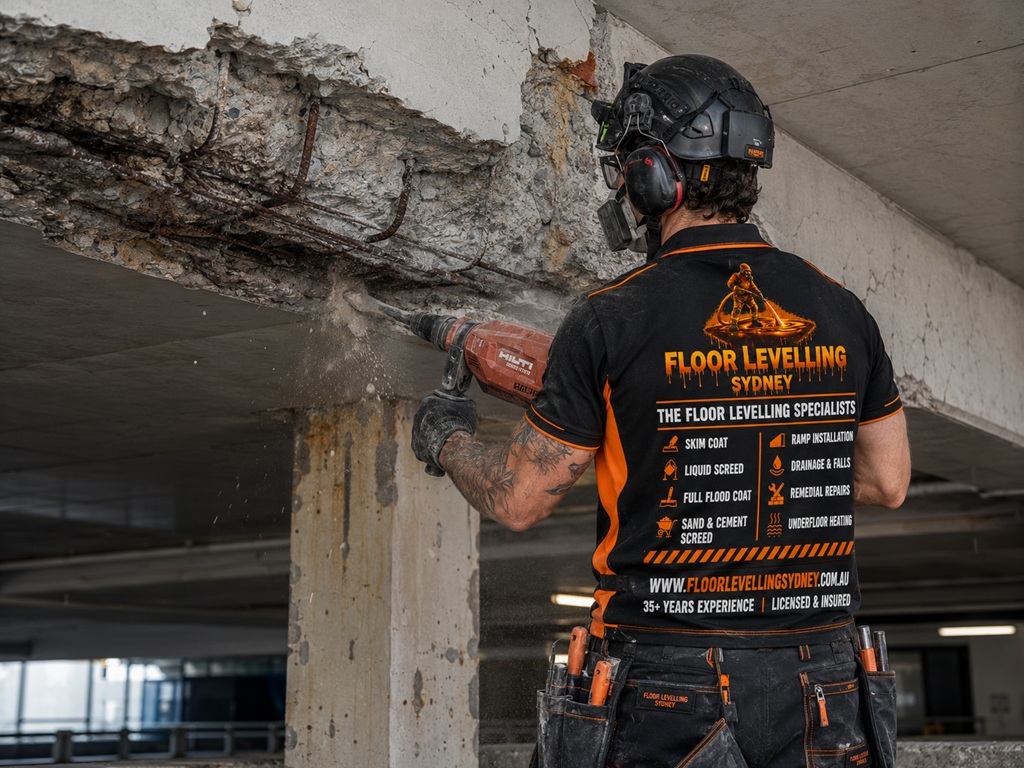
– Rust stains appearing on concrete surfaces
– Cracks forming in walls, floors, or ceilings
– Flaking or crumbling concrete
– Persistent moisture stains
– Failing expansion joints
– Reinforcement steel positioned too close to the surface
– Corrosion of metal fixtures embedded in concrete
– Bubbling or peeling paint on concrete surfaces
– Hollow sounding concrete when tapped
– Visible reinforcement bars exposed through damaged concrete
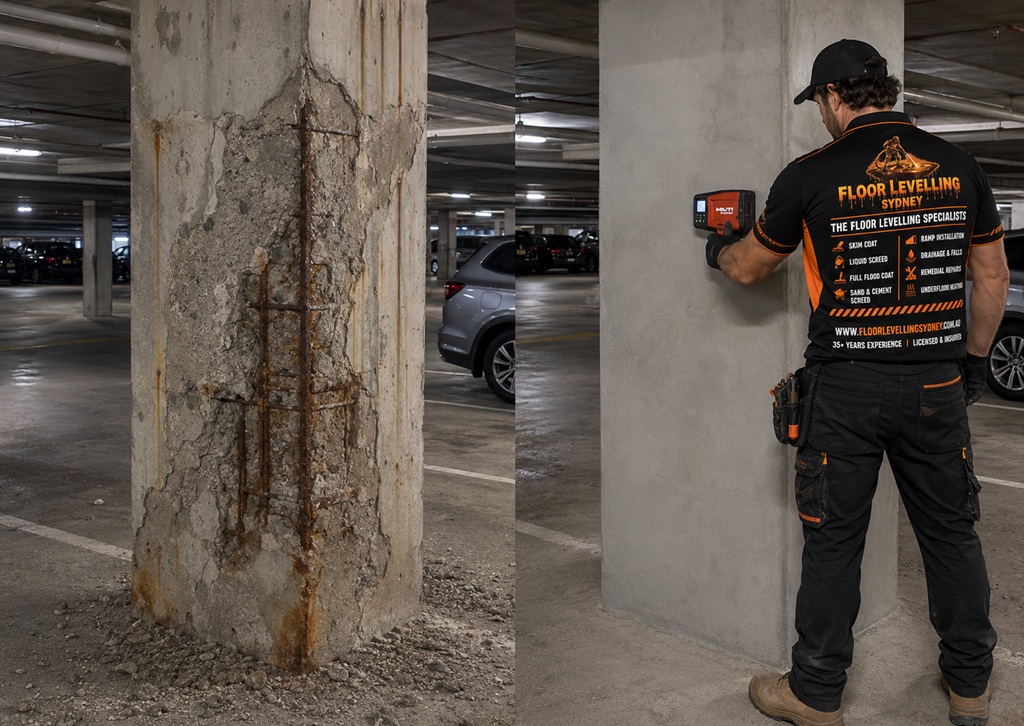
Factors That Can Cause Concrete Cancer
Several environmental and structural factors can contribute to the development of concrete cancer.
Magnesite Flooring:
Magnesite floor systems used in older buildings can retain moisture within the slab and contribute to steel corrosion.
Coastal Salt Exposure:
Salt carried in coastal air can penetrate the concrete and accelerate corrosion of the internal reinforcement.
Water Penetration:
Moisture entering through cracks, joints, or porous concrete can eventually reach the reinforcement steel.
Carbonation:
As concrete ages, chemical reactions with carbon dioxide reduce its ability to protect embedded steel from corrosion.
Environmental Ageing:
Long-term exposure to weather, humidity, and pollutants gradually weakens the concrete structure.
Insufficient Concrete Cover:
Reinforcement bars located too close to the surface are more vulnerable to moisture and oxygen.
Poor Construction Practices:
Low-quality concrete mixes or incorrect reinforcement placement can shorten the lifespan of a structure.
Failed Waterproofing Systems:
When waterproofing membranes deteriorate, moisture can penetrate the structure and trigger corrosion.
Structural Movement:
Cracks caused by structural movement allow water to enter the concrete and accelerate deterioration.
Incompatible Metals:
Using different metals within the concrete structure can cause electrochemical reactions that accelerate corrosion.

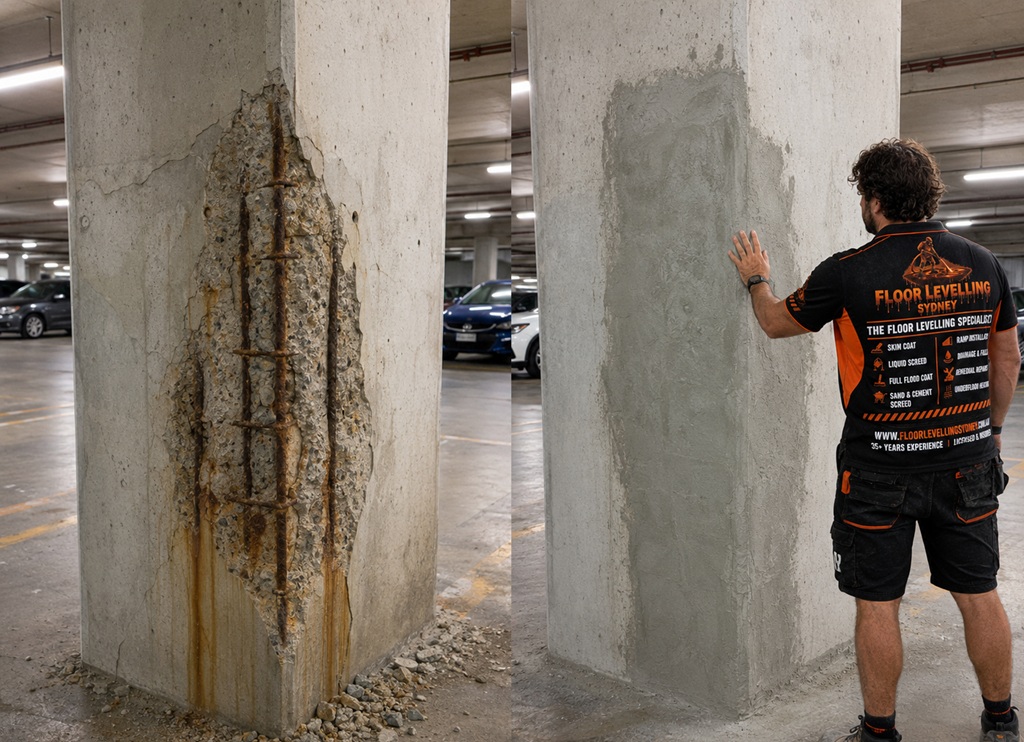
Concrete Cancer Repair Results – Before & After
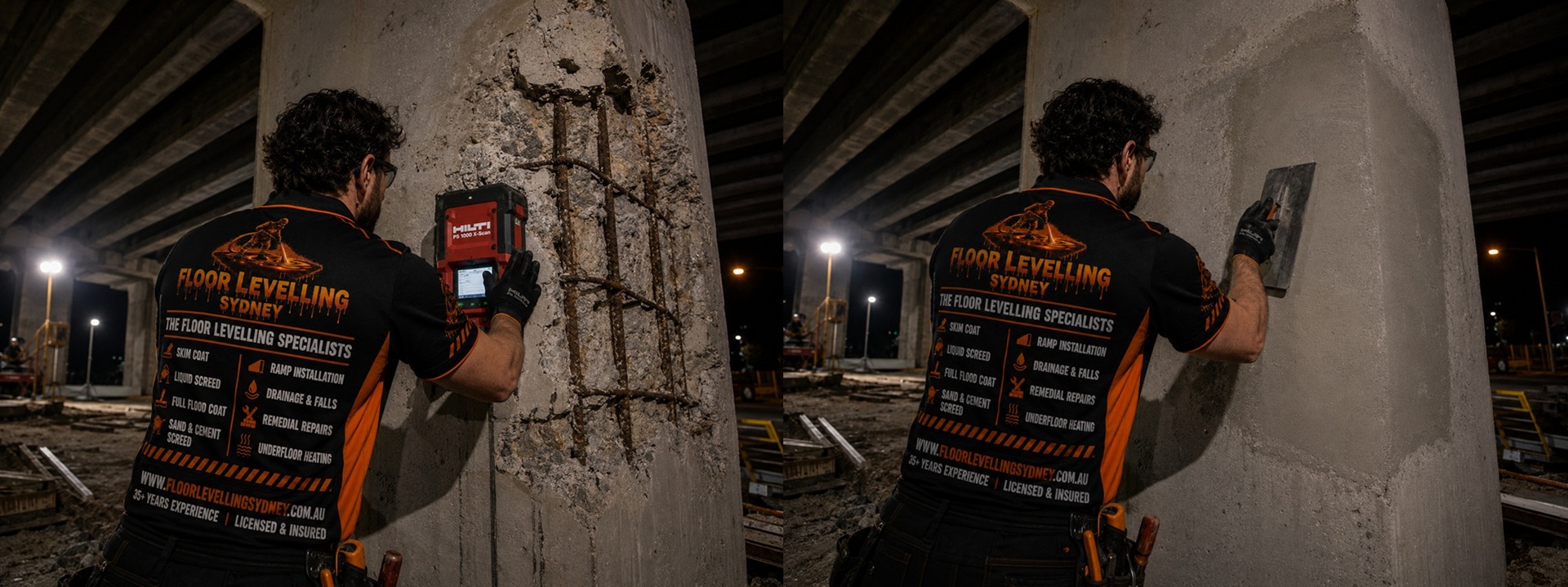
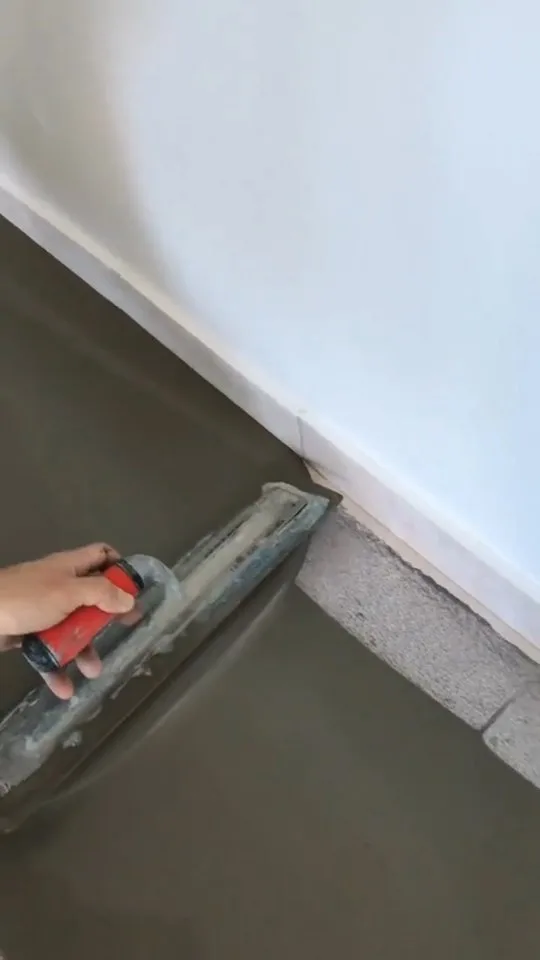
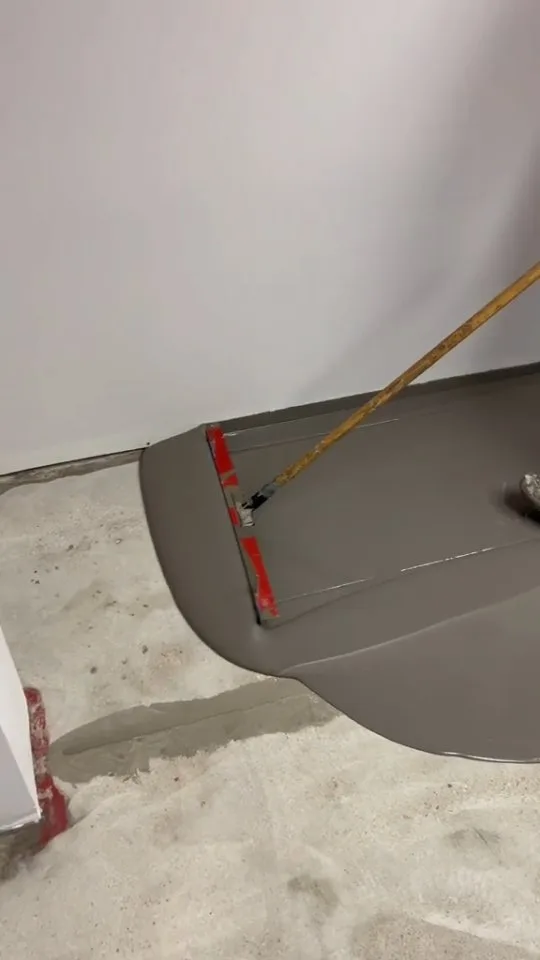
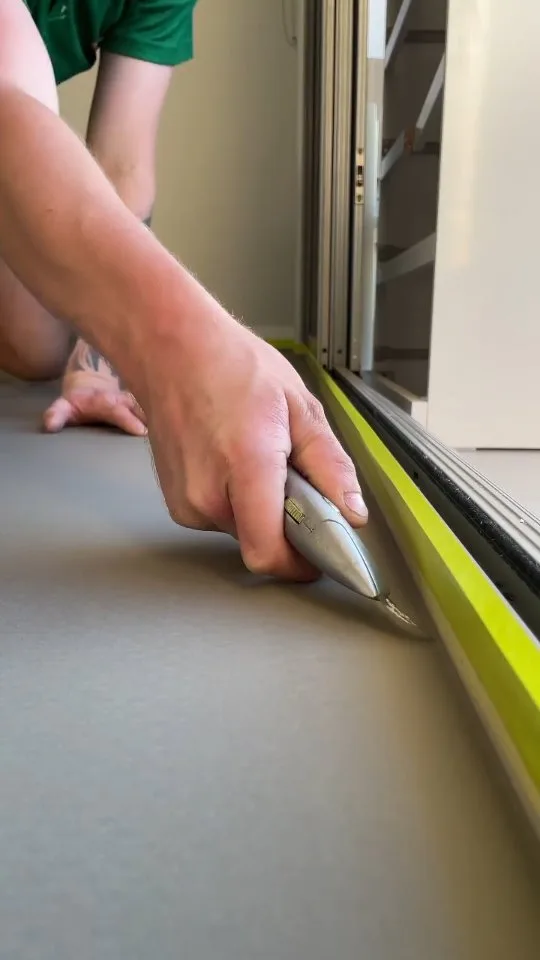
Take a look at our concrete cancer repair team in action and see the difference professional concrete remediation can make. Our before-and-after results show how we remove damaged and spalling concrete, expose and treat corroded reinforcement, apply suitable repair materials and restore the affected area to a safer, stronger and more durable condition.
Areas We Service Across Sydney
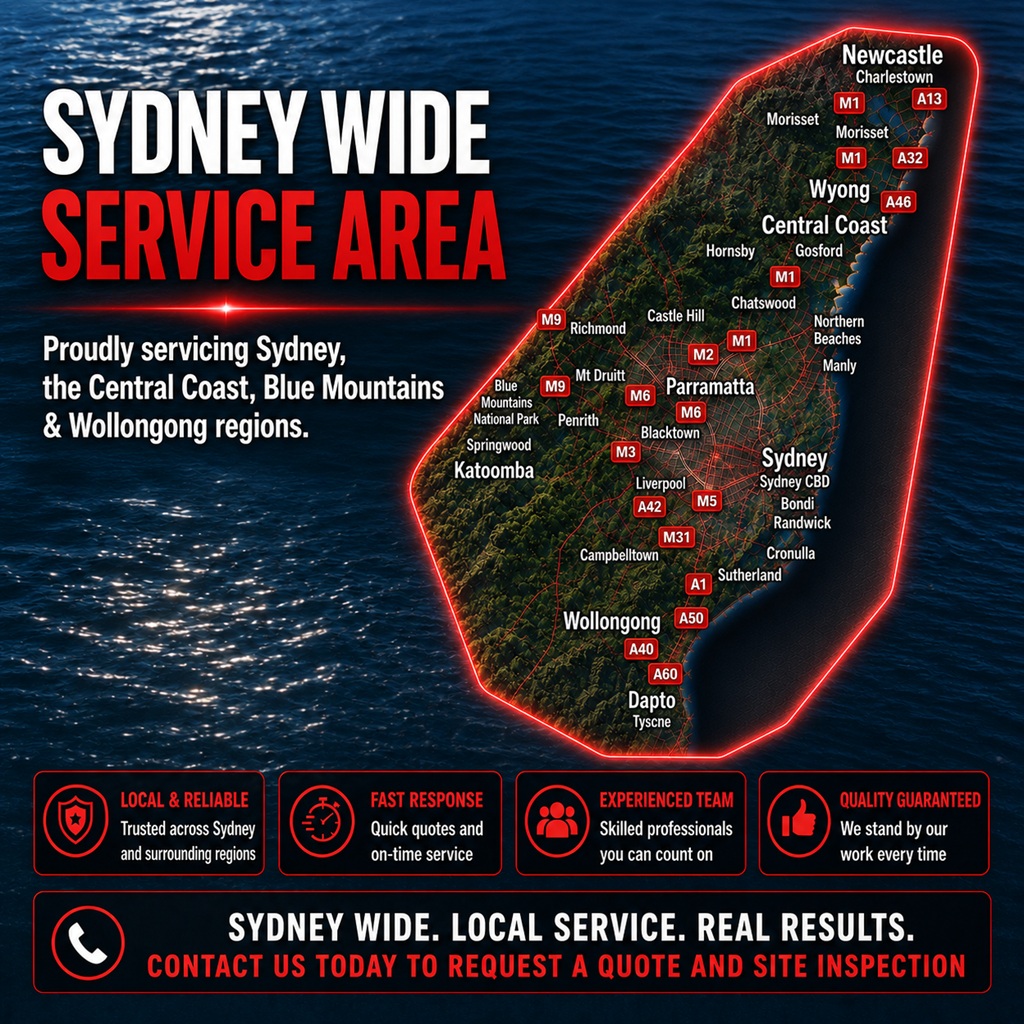
Floor Levelling Sydney provides Concrete Cancer Repair services across Sydney, Greater Sydney, Newcastle, Wollongong, and surrounding service regions.
We commonly service:
– Sydney CBD
– Inner West
– Eastern Suburbs
– Northern Beaches
– Lower North Shore
– Upper North Shore
– Northern Sydney
– The Hills District
– North West Sydney
– Ryde
– St George
– Sutherland Shire
– South Sydney
– South West Sydney
– Western Sydney
– Greater Western Sydney
Common service areas include:
– Chatswood
– North Sydney
– Ryde
– Parramatta
– Castle Hill
– Bella Vista
– Hornsby
– Brookvale
– Mona Vale
– Bondi
– Randwick
– Mascot
– Botany
– Alexandria
– Miranda
– Hurstville
– Kogarah
– Liverpool
– Bankstown
– Campbelltown
– Blacktown
– Penrith
– Wetherill Park
– Silverwater
– Seven Hills
– Prestons
– Ingleburn
We work across residential homes, apartment buildings, strata properties, commercial buildings, industrial sites and government properties.
Quality, Compliance & Concrete Cancer Repair Standards
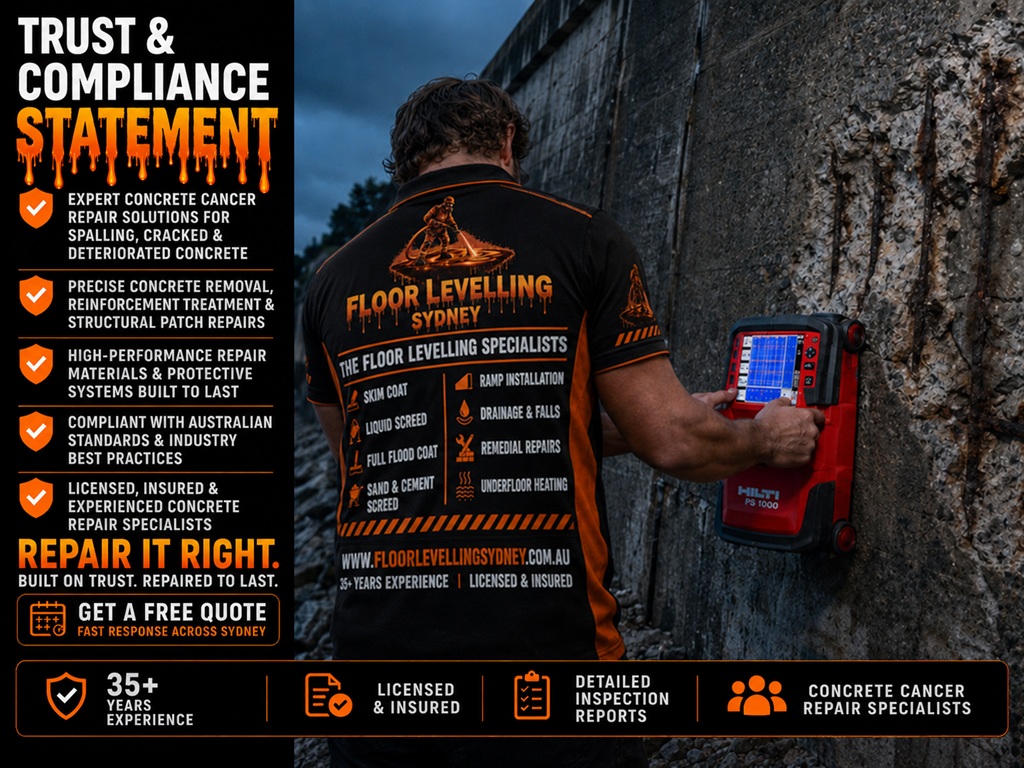
Our concrete cancer repair team completes remedial concrete work with a strong focus on accurate diagnosis, correct surface preparation, suitable repair methods, reinforcement treatment and long-term protection against further deterioration.
Our concrete cancer repair process is designed to align with manufacturer specifications, project requirements, relevant Australian Standards where applicable, and accepted industry practices for concrete remediation, corrosion treatment, structural patch repairs and protective coating systems.
This helps ensure:
– Accurate identification of concrete cancer and its underlying cause
– Proper removal of loose, damaged and contaminated concrete
– Correct exposure and cleaning of rusted reinforcement
– Suitable treatment or replacement of deteriorated reinforcing steel
– Strong adhesion between the existing concrete and repair materials
– Correct application of compatible concrete repair mortars
– Reduced risk of cracking, delamination or recurring concrete spalling
– Improved protection against moisture ingress and reinforcement corrosion
– Durable repairs suited to the structure, substrate and surrounding environment
Where required, our team uses professional concrete scanning, saw cutting, dust-controlled concrete removal, mechanical surface preparation, reinforcement cleaning, corrosion treatment and concrete repair methods to create a clean, stable and suitable repair area.
Once the affected reinforcement has been treated, compatible repair mortars or remediation systems can be applied to rebuild the damaged section, restore the concrete profile and help protect the structure against further deterioration.
Book A Concrete Cancer Repair Inspection In Sydney
If you have noticed cracked concrete, rust staining, exposed reinforcement, loose concrete, concrete spalling, falling concrete or moisture-related deterioration, it is important to investigate the problem before it becomes more extensive.
Floor Levelling Sydney can inspect the affected area, assess the condition of the concrete and reinforcement, identify visible signs of corrosion and provide a clear quote for concrete cancer repairs, reinforcement treatment, concrete patching or related remedial works.
Call or text 0424 408 330 to book a concrete cancer repair inspection in Sydney.
Our Concrete Cancer Repair FAQs
Below are answers to the most common questions we receive about professional concrete cancer repairs.
DO YOU NEED HELP WITH A SERVICE?
Fill out the form and our team will contact you!
"*" indicates required fields
FREE
QUOTE
Free Quote & Site inspection*
Conditions apply. *Cannot be used in conjunction with any other offer.
FREE QUOTE CALL OR TEXT
0424 408 330
Trusted by Builders, Strata Managers & Property Owners
GET YOUR JOB BOOKED IN AND FINISHED TODAY !!
"*" indicates required fields
"*" indicates required fields
"*" indicates required fields